If you haven’t already, check out Arun Ulag’s hero blog “FabCon and SQLCon 2026: Unifying databases and Fabric on a single, complete platform” for a complete look at all of our FabCon and SQLCon announcements across both Fabric and our database offerings.
For years, organizations have invested heavily in analytics to understand what happened in their business. Dashboards, reports, and KPIs are now table stakes. But when it comes to planning—budgets, forecasts, scenarios, and targets—most teams still rely on disconnected tools, manual processes, and stale data. The result is a familiar challenge: leaders are asked to make high stakes decisions with fragmented context, competing assumptions, and plans that quickly drift away from reality.
Today at FabCon Atlanta, we’re introducing Planning in Fabric IQ —a new enterprise planning capability that brings financial and business planning directly into Microsoft Fabric’s unified data and intelligence platform. This capability is co-engineered with Lumel, an award-winning innovator in enterprise performance management.
With Planning in Fabric IQ, organizations can build budgets, forecasts, targets, and scenario models directly on top of governed Fabric data and shared semantics—so planning becomes a natural extension of how the business measures performance and drives action
Planning in Fabric IQ
Traditional planning tools live outside the data platform. They require constant data movement, reconciliation, and rework as assumptions change. The result is familiar:
- Plans drift away from actuals
- Teams operate with different versions of the truth
- Forecasts lag behind real world change
- AI systems lack the business intent needed to act responsibly
The challenge isn’t access to data—it’s the disconnect between historical performance, current operations, and future intent.
Planning in Fabric IQ closes that gap by bringing planning into the same governed, semantic foundation as your data.
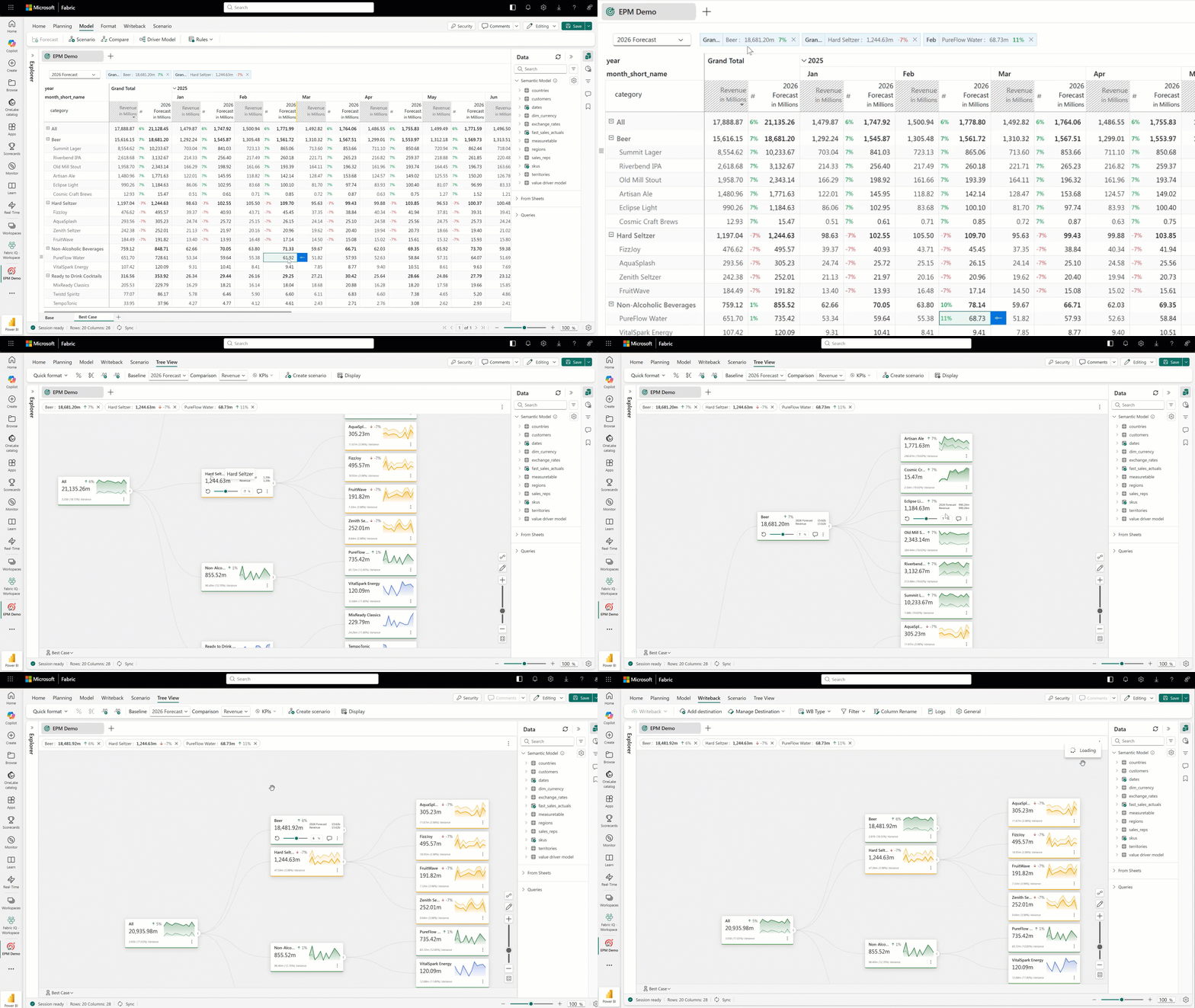
Figure: Animated gif Planning in Fabric IQ.
Planning capabilities
Planning, natively built in Microsoft Fabric
Planning in Fabric is built directly on Fabric’s foundation, and this enables Planning to seamlessly connect to:
- Power BI semantic models for trusted business metrics
- Fabric SQL for writeback operations
- OneLake for unified analytical and operational data
Instead of exporting data into planning silos, teams can build planning models where their data already lives. Business users can start with historical performance, layer in targets and forecasts, collaborate in context, and write projections back securely—while seeing the impact flow through connected reports and dashboards. Team’s notifications keep users updated on actions required for review and approvals.
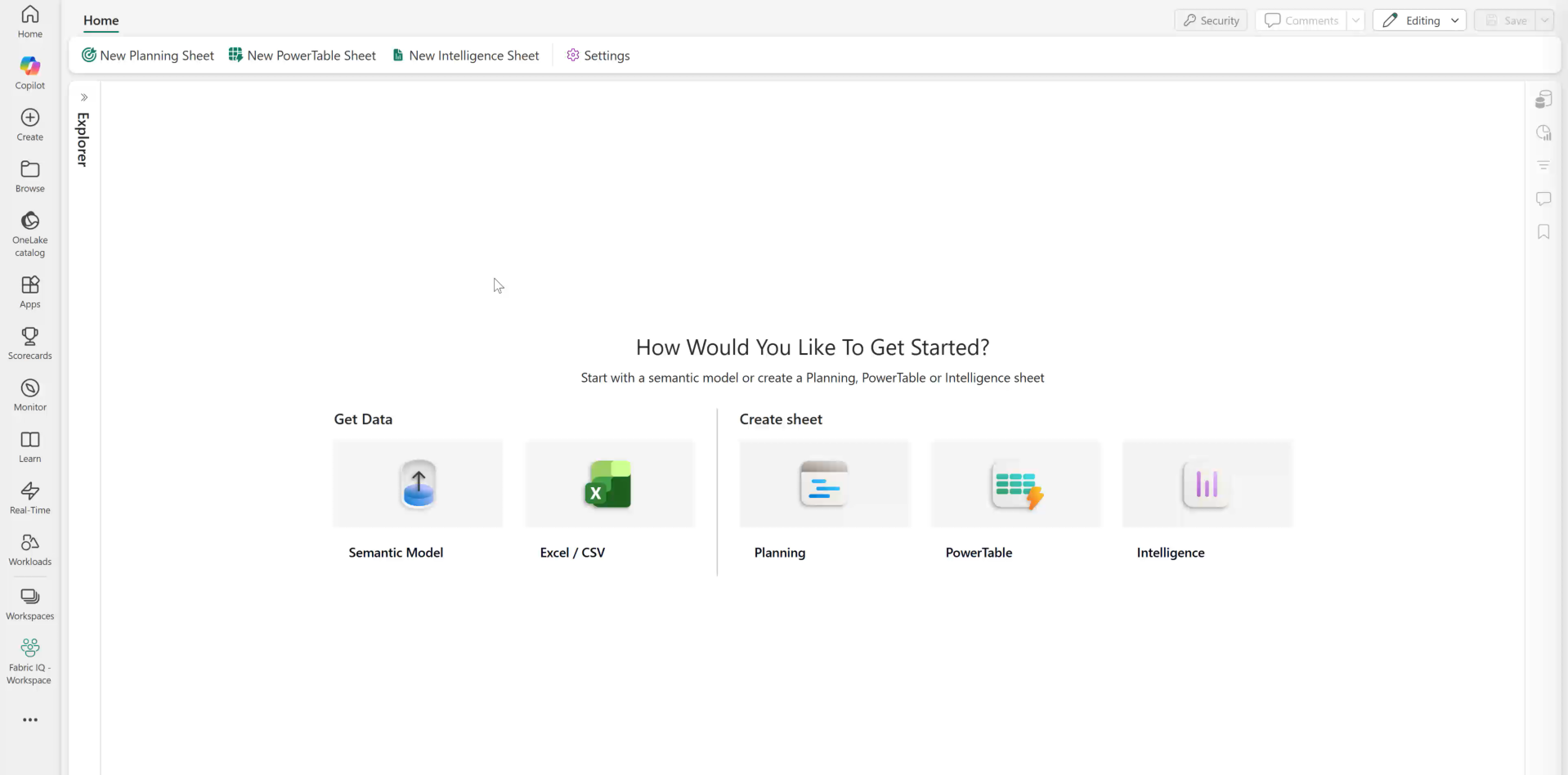 Figure: Planning in Fabric IQ
All of this happens without breaking governance, duplicating data, or introducing new integration overhead. OneLake’s mirroring and shortcut capabilities let you bring enterprise data directly into planning workflows without the need for ETL.
Integrated Budgeting, Forecasting, and Scenario Modeling
Fabric Planning provides enterprise-grade planning tools for budgeting, forecasts, scenario analysis, what-if assessments, and both top-down and bottom-up workflows.
Users can simulate multiple scenarios and compare outcomes instantly to support more confident strategic decisions.
Collaborative Enterprise Planning
Planning typically involves multiple teams working together. Fabric Planning facilitates cross-functional collaboration by providing integrated workflow management, approval processes, audit trails, role-based access controls, and robust governance features.
These capabilities ensure that planning becomes a collaborative process across finance, operations, and leadership teams
No-Code Self-Service Experience
Fabric Planning is built for business users—not developers—using a no-code experience that enables teams to create and manage planning models without heavy IT involvement. This allows organizations to deploy self-service planning applications in minutes instead of months, reduce reliance on consultants or specialized developers, and confidently scale planning across departments while maintaining governance.
Seamless Integration with Analytics and Reporting
Fabric Planning works seamlessly with analytics and reporting to give organizations a complete view of performance. By combining planning and analytics in a single environment, teams can analyze plan vs. actuals, explore insights through interactive dashboards and IBCS compliant financial visualizations, and perform ad hoc analysis—enabling them to move from insight to action faster.
From static plans to business context
What makes Planning in Fabric IQ different isn’t just integration—it’s that planning becomes part of your organization’s business model.
By placing plans directly alongside operational and analytical data, Planning creates a single, trusted foundation where actuals, targets, and assumptions are always in sync. Variance analysis becomes immediate and actionable, reference data updates flow through in real time, and scenarios adjust dynamically as conditions change—enabling faster, more confident decision making.
Leaders gain a forward-looking view grounded in real business signals, while teams continuously refine plans through seamless collaboration across planners, stakeholders, and viewers—turning planning into a living, enterprise-wide capability rather than a static exercise.
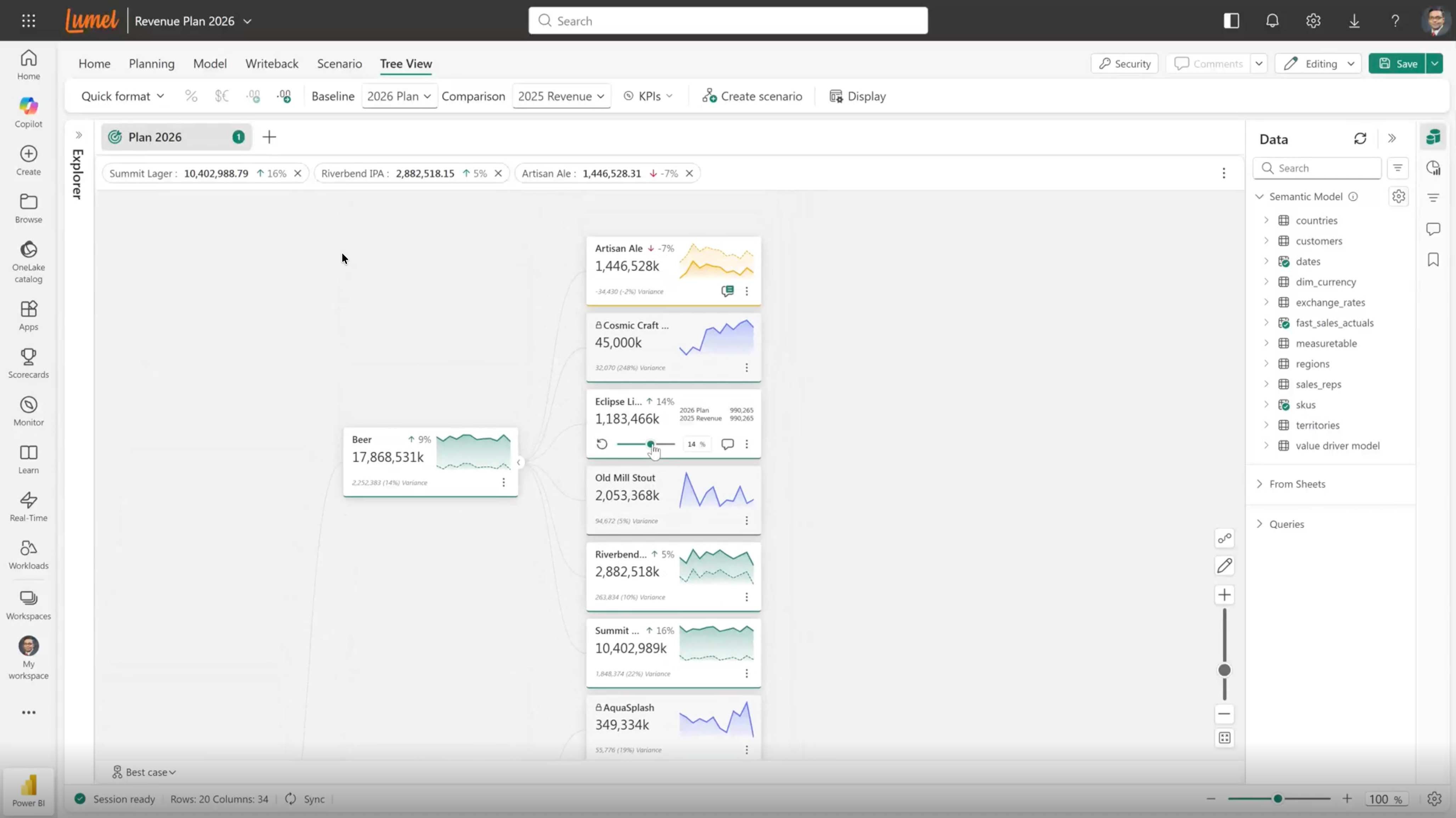
Figure: Planning breakdown
This shared context is essential as organizations move toward AI assisted decision making. AI can respond more accurately when it understands not just the state of the business, but the intent behind negotiations, constraints, and tradeoffs.
Planning in Fabric IQ provides that intent layer, extending Fabric IQ’s semantic foundation from insight into action.
Planning as the foundation for intelligent action
Planning in Fabric IQ does more than improve forecasts—it establishes the business intent layer required for intelligent systems to move from insight to action. As organizations adopt AI assisted decision making, the question is no longer whether AI can analyze data, but whether it understands what the business is trying to achieve.
By embedding planning directly into Fabric’s governed data and semantic foundation, Planning in Fabric IQ provides the missing context AI systems need: goals, targets, constraints, and tradeoffs—all expressed in the language of the business. This shared understanding becomes critical as enterprises explore AI agents that reason over data, recommend actions, and operate within defined boundaries.
In this model, planning serves as the connective tissue between data and action. Plans define what success looks like; shared semantics enables consistency across metrics and scenarios; and AI powered experiences can reason against this context to support smarter decisions. Rather than acting on raw signals or isolated KPIs, AI agents are grounded in a coherent business model that reflects how the organization operates.
Over time, this foundation enables a new class of data aware and intent aware agents—capable of analyzing variance, evaluating scenarios, and surfacing recommendations that align with business priorities. Planning in Fabric IQ doesn’t just inform decisions; it helps ensure that intelligent systems act responsibly, transparently, and in service of clearly defined outcomes.
This is how Fabric evolves from a system of insight to a platform for intelligent execution—where planning, data, and AI work together to help organizations move faster, adapt continuously, and turn intelligence into action.
Getting started
The preview of Planning in Fabric IQ is now accessible to organizations worldwide in Microsoft Fabric, as part of the Microsoft Fabric SKU, and new meters have been created. [1]For the latest details on Planning billing meters, go to Microsoft Learn (Fabric Operations).
Begin your 60-day Fabric trial and get started with Microsoft Fabric!
-
All meters are expected to be available by June 2026. ↑
Related blog posts
Introducing Planning in Microsoft Fabric IQ: From historical data to forecasting the future
Fabric Data Factory at FabCon Atlanta: Built for modern data integration
If you haven’t already, check out Arun Ulag’s hero blog “FabCon and SQLCon 2026: Unifying databases and Fabric on a single, complete platform” for a complete look at all of our FabCon and SQLCon announcements across both Fabric and our database offerings. At FabCon Atlanta, we’re doubling down on a simple truth: every successful analytics, … Continue reading “Fabric Data Factory at FabCon Atlanta: Built for modern data integration”
The power of the Microsoft Fabric ecosystem: ISVs building natively on Fabric
If you haven’t already, check out Arun Ulag’s hero blog “FabCon and SQLCon 2026: Unifying databases and Fabric on a single, complete platform” for a complete look at all of our FabCon and SQLCon announcements across both Fabric and our database offerings. At Microsoft, we’ve always believed that platforms win when ecosystems thrive. Each year, … Continue reading “The power of the Microsoft Fabric ecosystem: ISVs building natively on Fabric”
Microsoft Fabric
Accelerate your data potential with a unified analytics solution that connects it all. Microsoft Fabric enables you to manage your data in one place with a suite of analytics experiences that seamlessly work together, all hosted on a lake-centric SaaS solution for simplicity and to maintain a single source of truth.
Get the latest news from Microsoft Fabric Blog
This will prompt you to login with your Microsoft account to subscribe
Visit our product blogs
View articles by category
- Activator
- AI
- Announcements
- Apache Iceberg
- Apache Spark
- Community
- Community Challenge
- Data Engineering
- Data Factory
- Data Lake
- Data Science
- Data Warehouse
- Databases
- Developer
- Fabric IQ
- Fabric ML
- Fabric platform
- Fabric Public APIs
- Lakehouse
- Machine Learning
- Microsoft Fabric
- Monthly Update
- OneLake
- Power BI
- Power BI reports
- Real-Time Intelligence
- Roadmap
- semantic model
- Uncategorized
View articles by date
- March 2026
- February 2026
- January 2026
- December 2025
- November 2025
- October 2025
- September 2025
- August 2025
- July 2025
- June 2025
- May 2025
- April 2025
- March 2025
- February 2025
- January 2025
- December 2024
- November 2024
- October 2024
- September 2024
- August 2024
- July 2024
- June 2024
- May 2024
- April 2024
- March 2024
- February 2024
- January 2024
- December 2023
- November 2023
- October 2023
- September 2023
- August 2023
- July 2023
- June 2023
- May 2023
- April 2023
- March 2023
- February 2023
- January 2023
- December 2022
- November 2022
- October 2022
- September 2022
- August 2022
- July 2022
- June 2022
- May 2022
- April 2022
What's new
- Microsoft 365
- Games
- Surface Pro 9
- Surface Laptop 5
- Surface Laptop Studio
- Surface Laptop Go 2
- Windows 11 apps
Microsoft Store
Education
- Microsoft in education
- Devices for education
- Microsoft Teams for Education
- Microsoft 365 Education
- Office Education
- Educator training and development
- Deals for students and parents
- Azure for students
Business
- Microsoft Cloud
- Microsoft Security
- Azure
- Dynamics 365
- Microsoft 365
- Microsoft Advertising
- Microsoft Industry
- Microsoft Teams
Developer & IT
- Developer Centre
- Documentation
- Microsoft Learn
- Microsoft Tech Community
- Azure Marketplace
- AppSource
- Microsoft Power Platform
- Visual Studio
Company
- © 2026 Microsoft