If you haven’t already, check out Arun Ulag’s hero blog “FabCon and SQLCon 2026: Unifying databases and Fabric on a single, complete platform” for a complete look at all of our FabCon and SQLCon announcements across both Fabric and our database offerings.
Coauthor: Bogdan Crivat
Across industries, organizations are rethinking their analytics foundation. The era of stitching together separate engines for ETL, data warehousing, and BI is giving way to unified platforms purpose-built for real-time insights and AI at scale. This transformation is reflected in the market momentum behind Microsoft Fabric, which has surpassed a $2 billion annual revenue run rate, serves more than 31,000 customers, and is growing revenue at 60% year over year—making it the fastest-growing analytics platform in the market.
For organizations running Azure Synapse Analytics and Azure Data Factory, migration to Fabric represents the next step in that evolution. By unifying data integration, engineering, warehousing into a single SaaS experience, Fabric eliminates the operational overhead of managing disparate tools—and positions teams to move faster on AI-driven workloads.
Today, we’re excited to announce several new capabilities that make efforts to migrate from Azure Data Factory and Azure Synapse Analytics to Microsoft Fabric seamless.
Streamlining data pipelines with Fabric Data Factory
Organizations that have relied on Azure Data Factory and Azure Synapse pipelines have built critical data integration foundations that form the backbone of their business operations.
In Fabric, we’re introducing modern, cloud-native orchestration designed for scale, collaboration, and AI-powered productivity, without forcing teams to abandon the pipelines they’ve already invested in.
By migrating to Fabric Data Factory, Apollo Hospitals unified fragmented data pipelines into a single, governed platform—eliminating duplicate data movement, reducing integration and infrastructure costs, and simplifying enterprise‑wide governance. This foundation enables real‑time analytics and AI at scale, delivering faster insights, greater operational agility, and stronger support for consistent, high‑quality patient care across the network.
To make migration straightforward and at no cost, we’re introducing the public preview of Azure Data Factory & Azure Synapse pipelines migration assistant. The migration assistant is a guided experience built directly into the tools you use today and provides an assessment-first approach, helping teams understand compatibility, supported activities, and readiness before anything moves. When you’re ready, it automates the migration of pipelines into Fabric Data Factory, safely converting linked services into Fabric connections and disabling triggers by default so validation remains firmly in your control. The result is a predictable, low-risk modernization path that preserves existing logic while unlocking Fabric-native capabilities.
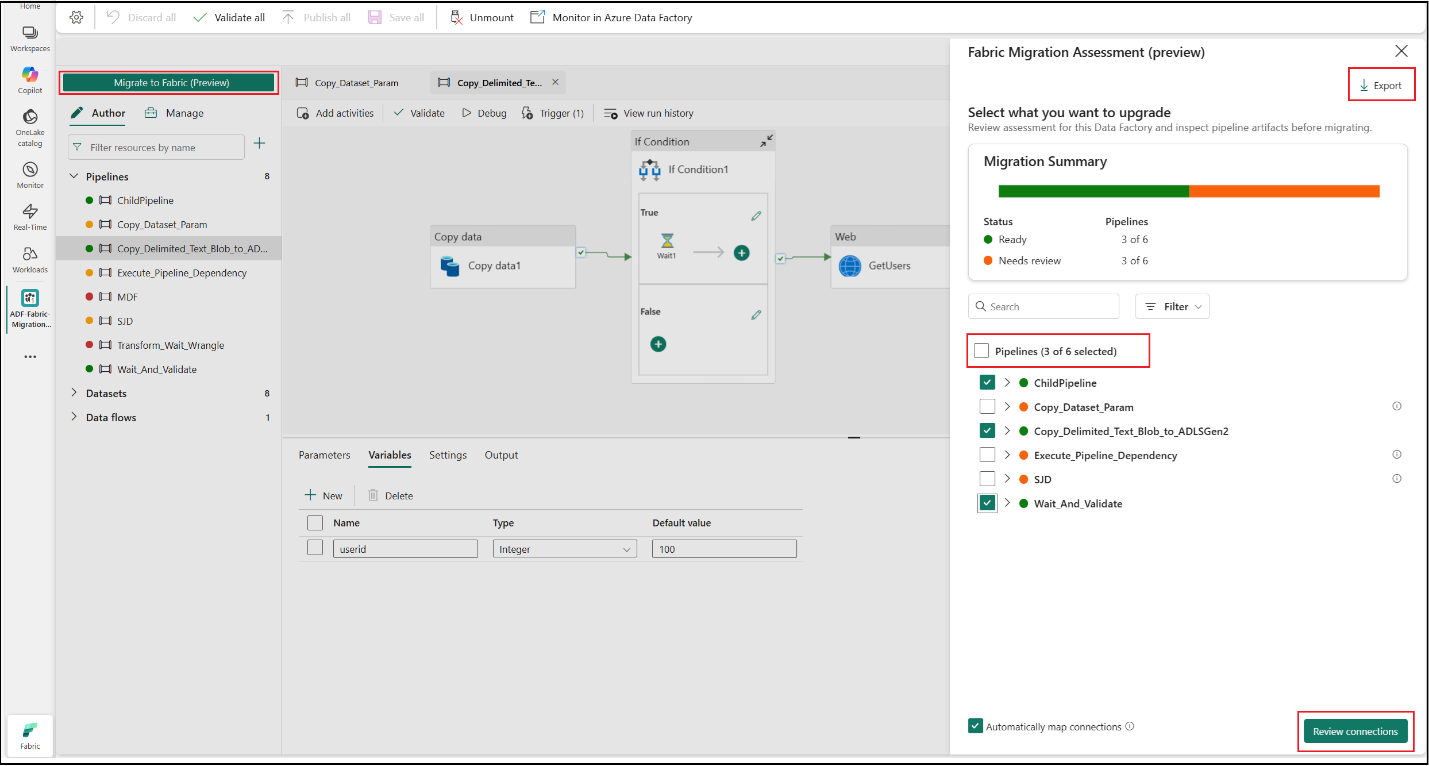
Figure: Pipeline migration summary in Fabric Data Factory
Migrating to Fabric Data Factory is a strategic step toward a more unified, intelligent, modern data platform. Once pipelines are in Fabric, teams can immediately take advantage of modern orchestration, unified monitoring, native integration with analytics workloads, and Copilot-powered experiences that accelerate development and operations.
We invite you to learn more about the migration assistant and use our guide to plan out your migration.
Modernizing Spark workloads with Fabric Data Engineering
Organizations are moving Apache Spark workloads to Microsoft Fabric to achieve superior price*performance and simplify operations at scale. Spark in Fabric offers a range of differentiated features including the Native Execution Engine, high concurrency support, starter pools and more. For many customers, the remaining challenge hasn’t been the value, but the effort required to get there. Rebuilding Spark pools, recreating notebooks and job definitions, and remapping lake databases introduces friction and risk.
The Synapse Spark to Fabric Data Engineering migration assistant, now in public preview, removes that barrier and makes it practical to modernize Spark estates quickly and with confidence. Built directly into the Fabric experience, the migration assistant automatically migrates core Spark artifacts from Azure Synapse Analytics into Fabric Data Engineering. It brings over Spark pools into Fabric pools and environments, migrates notebooks and Spark job definitions, and maps lake databases using OneLake catalog shortcuts.
Critically, no data is moved during the process. Spark artifacts are copied while data stays in place, so existing pipelines continue running with zero downtime. Each migration generates a detailed report showing what was migrated and what needs attention, giving teams clear visibility and control. Delivered through a guided wizard in Fabric, the experience lets users select a source Synapse workspace, choose a target Fabric workspace, optionally configure lake database migration, and start the process in minutes. Fabric then tracks progress and flags issues such as unsupported runtimes or naming conflicts with actionable guidance.
This migration assistant dramatically lowers the cost and complexity of moving from Azure Synapse Spark to Fabric—helping teams unlock faster startup times, simpler operations, and a more unified Spark experience sooner.
To learn more about the migration assistant, check out the Migrate to Fabric documentation.
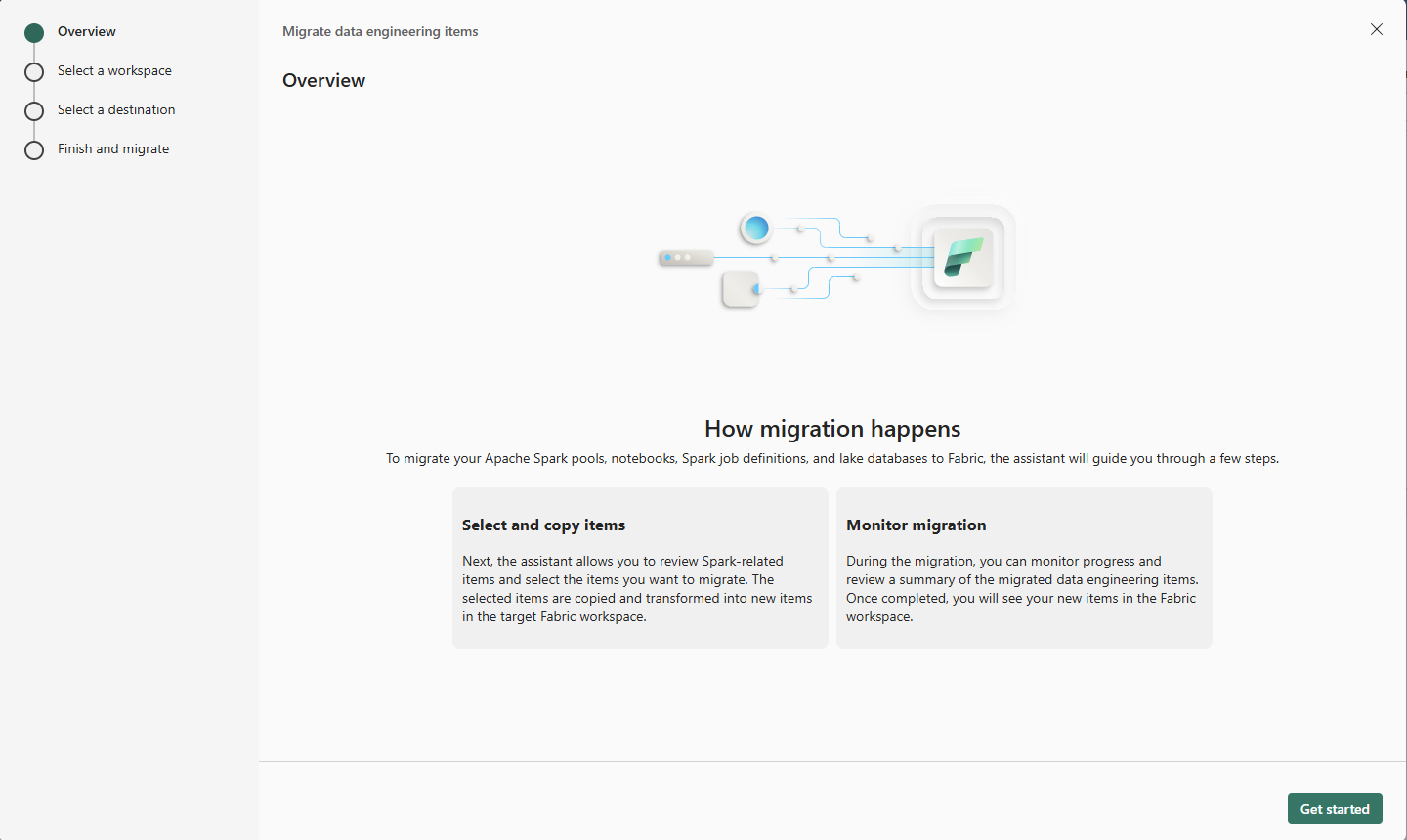
Figure: Wizard steps in the migration assistant to Fabric Data Engineering
Customers like OBOS BBL, one of the largest residential developers and housing cooperatives in the Nordics, modernized its Apache Spark estate by migrating from Azure Synapse to Microsoft Fabric Data Engineering. By moving 600+ notebooks and pipelines and consolidating thousands of data objects into a lakehouse architecture, OBOS achieved 30% faster processing, 20% lower operational costs, and consistent, scalable governance—without disrupting active users.
“We deliberately ran the old and new environments in parallel, comparing row and column counts and validating business KPIs through live reports before we switched anything over. That rigorous validation mattered, because for a data platform like ours, trust is the product.”
-Dag Erlend Berger, Product Lead for the Data Platform, OBOS
Accelerating query performance with Fabric Data Warehouse
Fabric Data Warehouse was built from the ground up in the 2020s, drawing upon decades of Microsoft expertise in databases and cloud, to deliver best-of-breed price-performance for modern analytical workloads. For organizations managing data volumes in terabytes or petabytes, it provides superior performance and cost-efficiencies compared to Synapse dedicated SQL Pools.
We’ve built a migration guide and a migration assistant to simplify and automate this transition for existing Synapse customers. The migration assistant, directly built into your Fabric experience, provides you with guided experience to convert your artifacts from Synapse dedicated pools directly into Fabric data warehouse, helping with not just schema conversions but data movement as well. It delivers a clear, actionable snapshot of migration results alongside a detailed summary of items that need attention, and Copilot is available to help resolve issues on the spot.
Customers are already appreciating the efficiencies they gain with the simplified migration process. Nebraska Furniture Mart, a Berkshire Hathaway Company, which manages several BI reports and faced significant performance and resource pressures on their existing infrastructure, migrated to Fabric Data Warehouse using the migration assistant.
“The tool facilitated every step of the process, automatically addressed column type conflicts, and effectively handled data migration right after the metadata transfer”
– Siri Kakumanu Senior Manager, Data Analytics and Business Intelligence, Nebraska Furniture Mart
Since launching Migration Assistant last year, we’ve continued to expand its capabilities. Today, we’re also announcing the ability to connect to a live source instance and directly proceed with migration in preview.
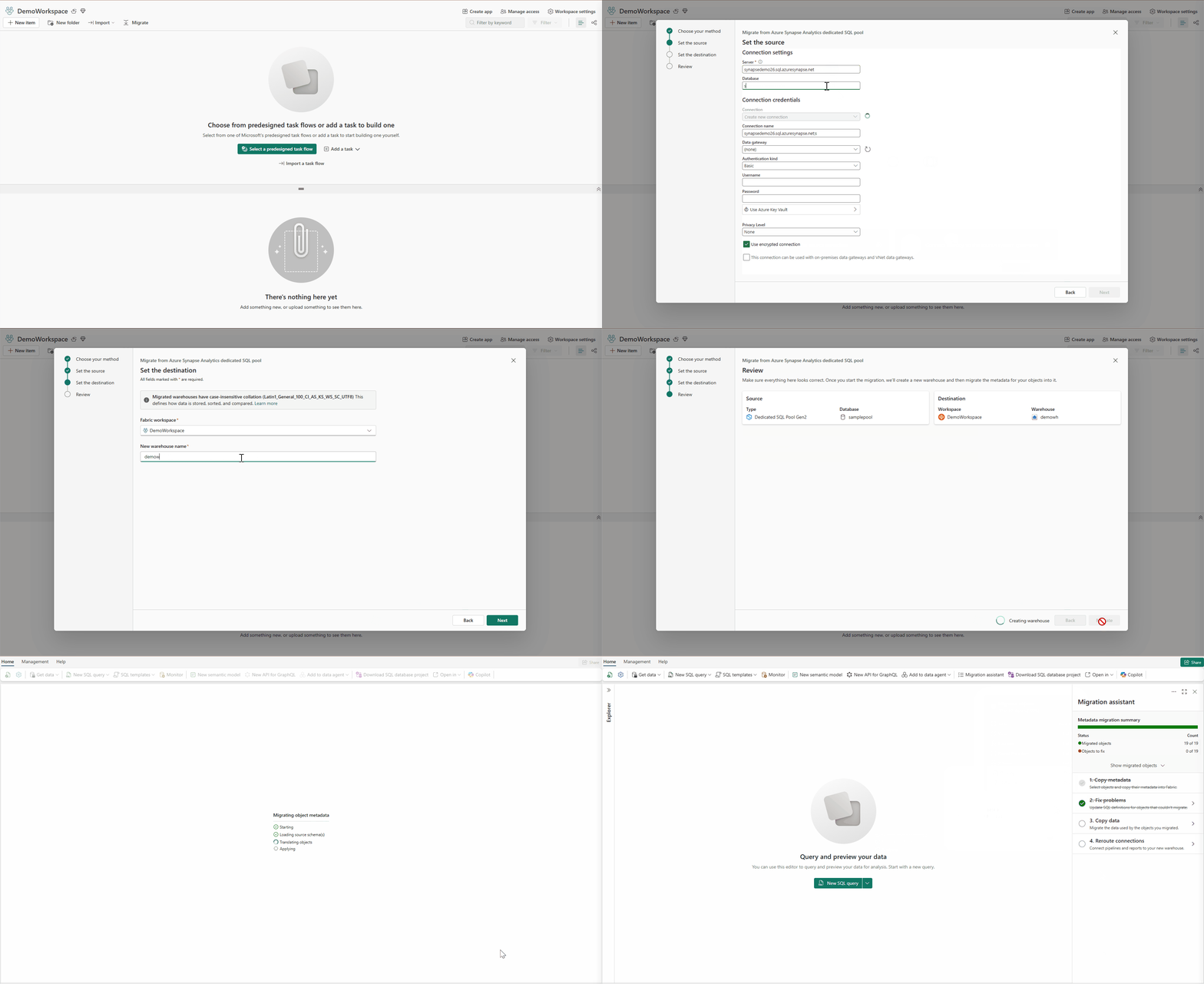
Figure: Connecting to a live source and starting migration in Fabric Data Warehouse
You can learn more about the new capabilities we’ve announced in the Fabric Data Warehouse migration assistant documentation and try them out in Fabric today.
The future of your Data Estate starts now
Whether you’re modernizing data pipelines, scaling analytics workloads, or simplifying Spark operations, these migration tools are designed to help you move forward with confidence and at your own pace. Start by assessing your current Synapse environment, explore the migration assistants available in Fabric, and begin planning your transition to a unified analytics platform built for the next generation of data and AI. If you’re looking for hands-on support, connect with your Microsoft account team or visit the Microsoft Fabric Community to learn from customers who’ve already made the move.
Related blog posts
From Azure Synapse and Azure Data Factory to Microsoft Fabric: The Next-Gen Analytics Leap
Fabric March 2026 Feature Summary
Welcome to the Fabric March 2026 Feature Summary—and welcome to FabCon! As we kick off FabCon, this update captures the momentum we’re seeing across the Fabric platform and the conversations happening with customers and partners right now. March brings a wide range of enhancements across governance, data engineering, real-time intelligence, data science, extensibility, and AI—all … Continue reading “Fabric March 2026 Feature Summary”
ExtractLabel: Schema-driven unstructured data extraction with Fabric AI Functions
Most enterprise data lives in free text – tickets, contracts, feedback, clinical notes, and more. It holds critical information but doesn’t fit into the structured tables that pipelines expect. Traditionally, extracting structure meant rule-based parsers that break with every format to change, or custom NLP models that take weeks to build. LLMs opened new possibilities, … Continue reading “ExtractLabel: Schema-driven unstructured data extraction with Fabric AI Functions”
Microsoft Fabric
Accelerate your data potential with a unified analytics solution that connects it all. Microsoft Fabric enables you to manage your data in one place with a suite of analytics experiences that seamlessly work together, all hosted on a lake-centric SaaS solution for simplicity and to maintain a single source of truth.
Get the latest news from Microsoft Fabric Blog
This will prompt you to login with your Microsoft account to subscribe
Visit our product blogs
View articles by category
- Activator
- AI
- Announcements
- Apache Iceberg
- Apache Spark
- Community
- Community Challenge
- Data Engineering
- Data Factory
- Data Lake
- Data Science
- Data Warehouse
- Databases
- Developer
- Fabric IQ
- Fabric ML
- Fabric platform
- Fabric Public APIs
- Lakehouse
- Machine Learning
- Microsoft Fabric
- Monthly Update
- OneLake
- Power BI
- Power BI reports
- Real-Time Intelligence
- Roadmap
- semantic model
- Uncategorized
View articles by date
- March 2026
- February 2026
- January 2026
- December 2025
- November 2025
- October 2025
- September 2025
- August 2025
- July 2025
- June 2025
- May 2025
- April 2025
- March 2025
- February 2025
- January 2025
- December 2024
- November 2024
- October 2024
- September 2024
- August 2024
- July 2024
- June 2024
- May 2024
- April 2024
- March 2024
- February 2024
- January 2024
- December 2023
- November 2023
- October 2023
- September 2023
- August 2023
- July 2023
- June 2023
- May 2023
- April 2023
- March 2023
- February 2023
- January 2023
- December 2022
- November 2022
- October 2022
- September 2022
- August 2022
- July 2022
- June 2022
- May 2022
- April 2022
What's new
- Microsoft 365
- Games
- Surface Pro 9
- Surface Laptop 5
- Surface Laptop Studio
- Surface Laptop Go 2
- Windows 11 apps
Microsoft Store
Education
- Microsoft in education
- Devices for education
- Microsoft Teams for Education
- Microsoft 365 Education
- Office Education
- Educator training and development
- Deals for students and parents
- Azure for students
Business
- Microsoft Cloud
- Microsoft Security
- Azure
- Dynamics 365
- Microsoft 365
- Microsoft Advertising
- Microsoft Industry
- Microsoft Teams
Developer & IT
- Developer Centre
- Documentation
- Microsoft Learn
- Microsoft Tech Community
- Azure Marketplace
- AppSource
- Microsoft Power Platform
- Visual Studio
Company
- © 2026 Microsoft