If you haven’t already, check out Arun Ulag’s hero blog “FabCon and SQLCon 2026: Unifying databases and Fabric on a single, complete platform” for a complete look at all of our FabCon and SQLCon announcements across both Fabric and our database offerings.
We are releasing the preview of a domain‑native data solution built as a workload in Fabric to power analytics and AI-enabled use-cases for capital markets and hedge fund customers in the finance industry. Financial institutions are moving fast to modernize their analytics stack and accelerate AI adoption, however in capital markets, data complexity remains the single biggest blocker to achieving that goal.
Disparate source systems, inconsistent identifiers, manual reconciliation, and strict regulatory requirements make it difficult to create trusted data assets, let alone safely expose them to AI. This is exactly the problem Capital Markets Datahub on Microsoft Fabric is designed to solve.
The Capital Markets Datahub workload is a third-party solution, built using Fabric Extensibility Toolkit (FET) and Azure AI Foundry integration, delivering reconciled, governed, analytics and AI‑ready financial data directly into a customer’s Lakehouse and Eventhouse.
Why Capital Markets data is uniquely hard to reconcile and why it matters
Capital Markets operate with some of the most complex data in any industry:
Hundreds of external and internal data sources such as prime brokers, custodians, market data providers.
- Thousands of portfolios, instruments, and entities, each represented by multiple identifiers across financial systems.
- Continuous lifecycle events such as corporate actions, accruals, net/gross position changes.
- Real‑time expectations where intraday data matters and end‑of‑day data is already stale.
- Strict governance requirements around entitlements, PII, cross‑jurisdiction data residency, and auditability.
Simply ingesting data from different sources as “raw data” is not enough. Without applying the financial taxonomy, semantics, reconciliation logic, and entitlement controls, data remains fragmented and is not ready for use.
What is Capital Markets DataHub workload?
Capital Markets Datahub workload is not another generic warehouse. Instead, it is a financial data product and workload that makes Microsoft Fabric Capital Markets aware by embedding industry‑specific intelligence directly into the data layer.
At a high level, Capital Markets Datahub provides:
- 200+ Capital Markets connectors to banks, custodians, prime brokers, administrators, and market data providers
- A single Canonical Capital Markets data model that normalizes instruments, positions, trades and many more.
Built‑in reconciliation logic (> 99% accuracy) to resolve breaks and inconsistencies across providers
- Financial Services‑specific entitlements layered on top of Fabric governance
- AI‑ready datasets that Copilot and models can safely consume
The results in offering a solution that’s a single pane of glass available as a fully integrated experience with Fabric Lakehouse, Eventhouse, Power BI, notebooks, and extending to Azure AI Foundry and Microsoft Excel integration.
How Capital Markets Datahub works on Microsoft Fabric
Capital Markets Datahub workload is built using the Fabric Public REST APIs, tools and client SDKs made available in the Fabric Extensibility Toolkit that allows them to offer a unified and integrated experience to Fabric customers using their workload.
The workflow from data preparation, data delivery and data consumption goes through the following steps.

Figure: Schematic diagram of the E2E dataflow from ingestion to publish.
This turns Microsoft Fabric into a platform that now offers a Capital Markets‑ready data and AI data platform. Given financial services is a highly regulated industry the datahub solution also enforces zero trust AI by implementing fine grained security to manage business entitlements so users can see and interact with what they are authorized to see.
As a result, on top of the foundational datasets stored in OneLake, Capital Markets Datahub provides a custom natural language interface called Ask Datahub to its customers allowing users to ask questions such as:
- “Explain today’s exposure changes by strategy and sector.”
- “What is the latest Month- to- Date P&L by asset type?”
- “Summarize risk drivers impacting the portfolio this week.”
Because the data is reconciled, governed, and permissioned, Copilot and Agentic workflows can operate safely to deliver real business value. For Microsoft customers, this brings together the best of Fabric, Azure, and Copilot packaged in a workload to support some of the most data‑intensive and high‑value financial industry use-cases.
How the workload delivers value to customers
With Capital Markets Datahub on Microsoft Fabric, businesses can
- Reduce manual data wrangling and reconciliation effort
- Unify portfolio, risk, operations, and investor reporting on a single data foundation
- Accelerate time to value for analytics and AI initiatives
- Improve transparency and auditability for regulators and clients
- Enable AI adoption without compromising data security or governance
Get started
Capital Markets DataHub will be available as a Microsoft Fabric workload in the Fabric Workload Hub, offering Financial Industry customers and partners a path to explore the Capital Markets‑ready data foundation and tools on Microsoft Fabric.
To get started, navigate to the Fabric Workload Hub and add Capital Markets DataHub to your tenant.
Check out the demo video to learn about the complete end to end experience and features.
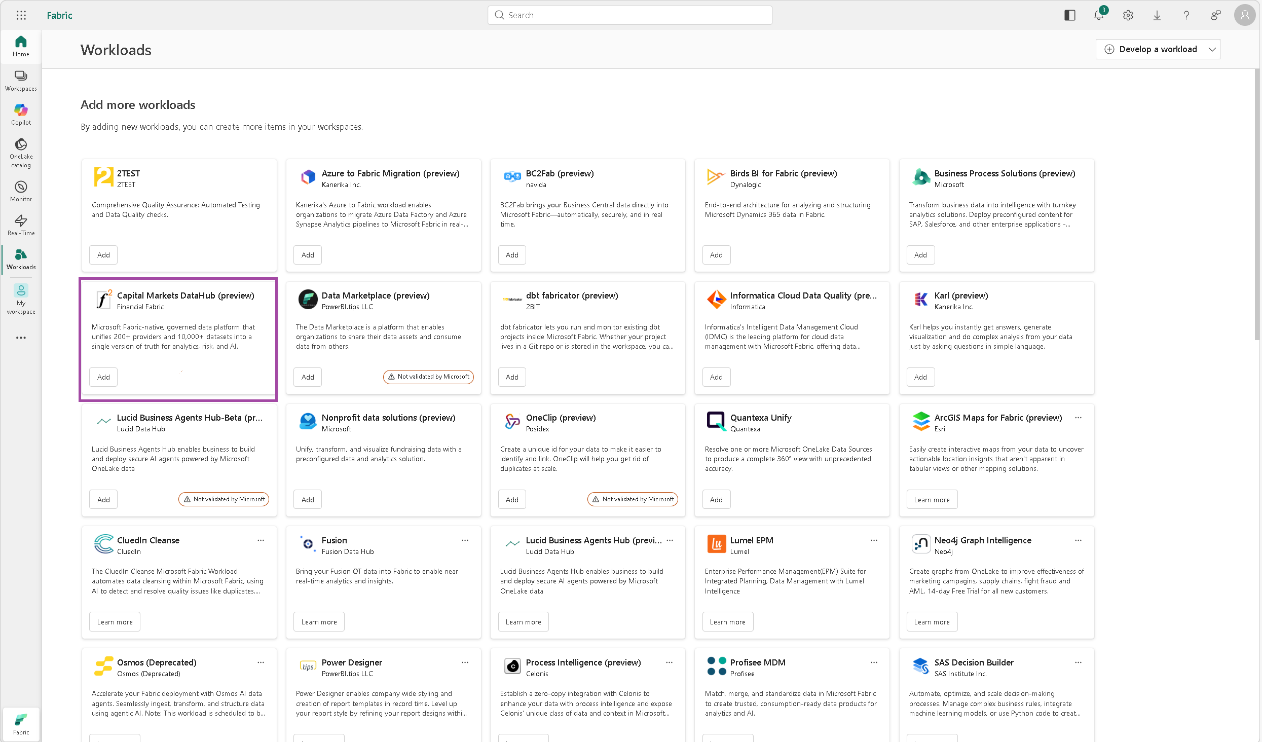
Figure: Schematic diagram of the E2E dataflow from ingestion to publish.
Additional resources
To learn more about the offer refer to the Azure Marketplace.
Refer to the Product Documentation for more information.
Related blog posts
Unlocking financial insights with Capital Markets DataHub workload—A partner-led innovation in Microsoft Fabric (Preview)
SQL Server Management Studio (SSMS) 22.4.1 and GitHub Copilot in SSMS (Generally Available)
GitHub Copilot in SQL Server Management Studio (SSMS) now offers a few highly requested features and several bug fixes based on feedback items. Check out the full release notes to learn about the complete list of updates in the 22.4.1 release. We appreciate you taking time to file issues, share your requests, and upvote items; you’ll notice your feedback helped us shape this release, and will help us continue to evolve the GitHub Copilot in SSMS integration.
Graph-powered AI reasoning (Preview)
As enterprises’ use of large language models (LLMs) evolve from generating text to driving decisions, the path to the answer has come to matter as much as the answer itself. Enterprises are moving beyond AI that merely generates responses toward systems for that reason, justify, and allow for inspection. This shift drives the need for AI that can ground explanations in each enterprise’s complex information environment, which requires the system to perform explicit reasoning over organizational, transactional, and behavioral relationships.
Microsoft Fabric
Accelerate your data potential with a unified analytics solution that connects it all. Microsoft Fabric enables you to manage your data in one place with a suite of analytics experiences that seamlessly work together, all hosted on a lake-centric SaaS solution for simplicity and to maintain a single source of truth.
Get the latest news from Microsoft Fabric Blog
This will prompt you to login with your Microsoft account to subscribe
Visit our product blogs
View articles by category
- Activator
- AI
- Announcements
- Apache Iceberg
- Apache Spark
- Community
- Community Challenge
- Data Engineering
- Data Factory
- Data Lake
- Data loss prevention
- Data Science
- Data Warehouse
- Databases
- Developer
- Fabric IQ
- Fabric ML
- Fabric platform
- Fabric Public APIs
- Fabric Workload
- Information protection
- Lakehouse
- Machine Learning
- Microsoft Fabric
- Monthly Update
- OneLake
- Power BI
- Power BI reports
- Real-Time Intelligence
- Roadmap
- Security and Compliance
- semantic model
- Uncategorized
View articles by date
- March 2026
- February 2026
- January 2026
- December 2025
- November 2025
- October 2025
- September 2025
- August 2025
- July 2025
- June 2025
- May 2025
- April 2025
- March 2025
- February 2025
- January 2025
- December 2024
- November 2024
- October 2024
- September 2024
- August 2024
- July 2024
- June 2024
- May 2024
- April 2024
- March 2024
- February 2024
- January 2024
- December 2023
- November 2023
- October 2023
- September 2023
- August 2023
- July 2023
- June 2023
- May 2023
- April 2023
- March 2023
- February 2023
- January 2023
- December 2022
- November 2022
- October 2022
- September 2022
- August 2022
- July 2022
- June 2022
- May 2022
- April 2022
What's new
- Microsoft 365
- Games
- Surface Pro 9
- Surface Laptop 5
- Surface Laptop Studio
- Surface Laptop Go 2
- Windows 11 apps
Microsoft Store
Education
- Microsoft in education
- Devices for education
- Microsoft Teams for Education
- Microsoft 365 Education
- Office Education
- Educator training and development
- Deals for students and parents
- Azure for students
Business
- Microsoft Cloud
- Microsoft Security
- Azure
- Dynamics 365
- Microsoft 365
- Microsoft Advertising
- Microsoft Industry
- Microsoft Teams
Developer & IT
- Developer Centre
- Documentation
- Microsoft Learn
- Microsoft Tech Community
- Azure Marketplace
- AppSource
- Microsoft Power Platform
- Visual Studio
Company
- © 2026 Microsoft